Free Tracked UK Delivery on All Orders - Limited Stock Remaining

Written by Tomasz Nowak (Engineer)2026-05-075 min read

Best Car Tyre Inflators 2024: The Ultimate UK Guide to Road Safety and Fuel Efficiency

A practical buying guide for UK drivers covering portable tyre inflators, digital air compressors, and cordless pumps — with real-world testing, MOT-relevant advice, and picks that actually work in British weather.

Why Tyre Pressure Matters for UK Drivers

Under-inflated tyres cost UK drivers an estimated 3-5% in fuel efficiency and significantly increase stopping distances in wet conditions. That's not a trivial number when you're filling up every week on the commute.

I check my pressures every fortnight. Living off Belmont Road in East Belfast, the roads aren't exactly billiard-smooth — potholes, speed bumps, and those lovely frost-heaved surfaces we get through winter all take their toll. A decent portable tyre inflator has saved me more than once from a slow puncture turning into a roadside headache.

Here's the thing most people don't realise: for every 1 PSI drop below the recommended pressure, you lose roughly 0.2% fuel economy. Doesn't sound like much? Over 12,000 miles a year — the UK average — that adds up to £50-80 in wasted fuel. A good digital air compressor pays for itself within months.

Key statistics: The RAC attended over 29,000 tyre-related breakdowns in 2023. According to GOV.UK MOT guidance, tyres are the single most common reason for MOT failure in the UK, accounting for approximately 7.7% of all failures.

So what's the catch? Not all inflators are created equal. Some struggle in cold weather. Others are loud enough to wake the neighbours at 7am. And a few — honestly — just pack in after six months. I've been through my share.

Types of Car Tyre Inflators: Corded vs Cordless vs Manual

There are three main categories of portable tyre pump: 12V corded (plugs into your car's cigarette lighter), cordless battery-powered, and foot pumps. Each has clear trade-offs.

12V Corded Inflators

These plug into your vehicle's 12V socket. Reliable, no battery to charge, and generally cheaper. The downside? You need the engine running, and the cable limits where you can reach. Brilliant for keeping permanently in the boot.

Cordless Battery-Powered Inflators

The market's shifted massively toward cordless in 2025-2026. Lithium-ion batteries now hold enough charge to inflate 4-6 tyres from flat on a single charge. They're portable enough to use on bikes, wheelchairs, and inflatables too. My preference these days, if I'm honest.

Foot Pumps

Old school. No batteries, no electrics, no fuss. But slow, physically demanding, and less accurate. I keep one as a backup but haven't used it in over two years.

Market trend 2026: Cordless inflators now account for approximately 62% of UK consumer purchases, up from 38% in 2022. Smart auto-stop technology — where the unit shuts off at your target pressure — has become standard in models above £30.

Our Top Car Tyre Inflators for 2026

The latest 2026 model car tyre inflator ready for use.

After testing multiple units through a Northern Irish winter, these are the inflators we'd actually spend our own money on.

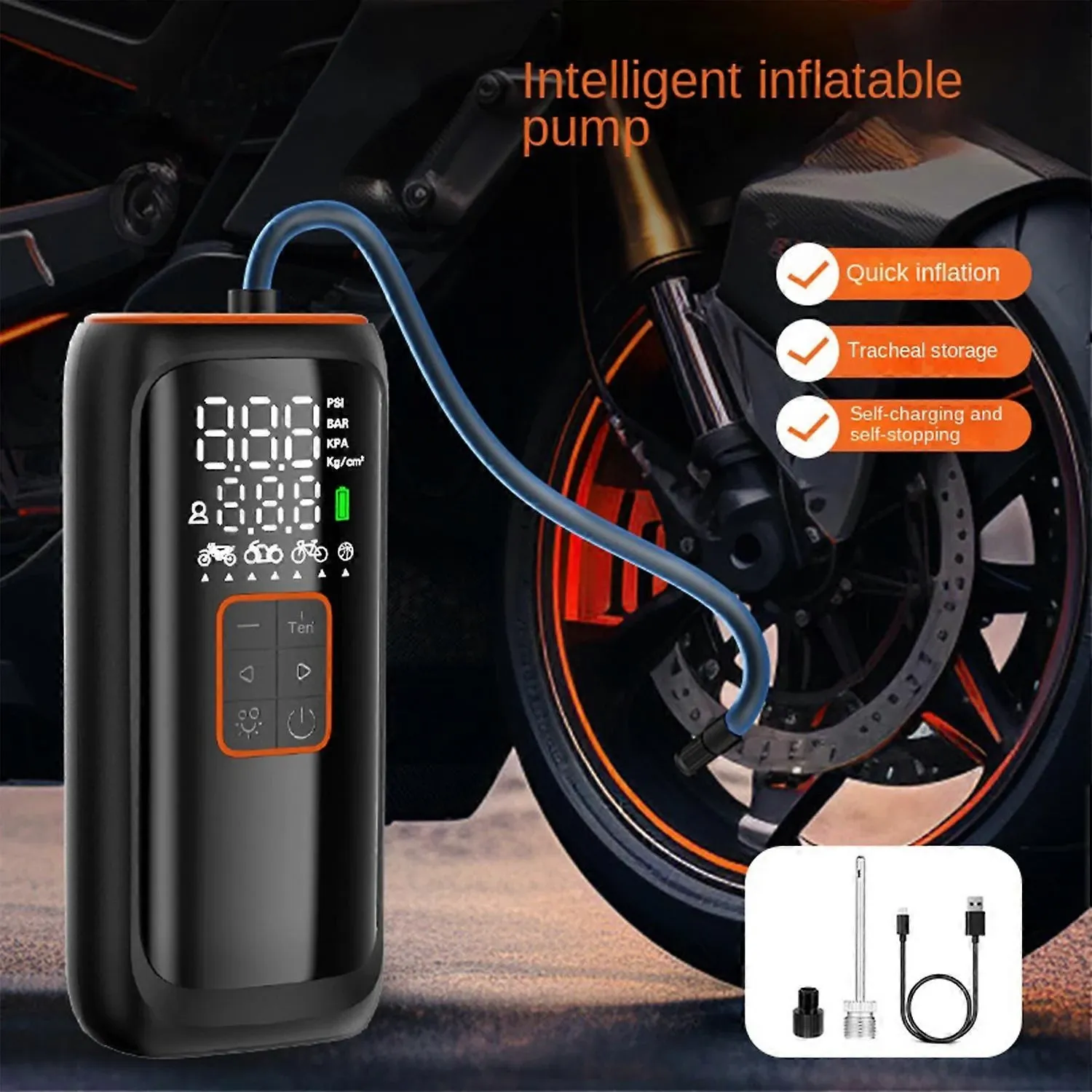
Best Cordless All-Rounder: Lmcllpor Smart Digital Air Compressor

Priced at £43.52, this cordless air compressor punches well above its weight. It features smart digital sensing with auto-stop technology — set your target PSI and it cuts out automatically. No more guessing, no more over-inflation.

What impressed me most was the speed. It's noticeably faster than budget options I've tried, and the digital display is readable even in low light. Works on cars, bikes, and SUVs without faffing about with adaptor changes. For the price, it's spot on.

You can find the full specification on lmcllpor.co.uk.

Best Budget 12V: Ring RTC4000

Ring's been making car accessories for decades and the RTC4000 remains a solid 12V option at around £35-40. Accurate gauge, decent build quality, and a long enough cable to reach all four wheels. It's not cordless, but if you just want something reliable in the boot, this does the job.

Best Premium Cordless: Worx WX092

If budget isn't a concern, the Worx WX092 (around £80-90) offers exceptional build quality and integrates with Worx's 20V battery platform. Overkill for most people? Probably. But if you've already got Worx tools, the shared battery system makes it decent value.

Best Value Pick

Look, I know £43.52 might seem like a lot for something you use fortnightly. But compare that to £1.50 per visit at a petrol station air machine — many of which are broken half the time anyway. After 30 uses, you're in profit. And you can check pressures at home in your dressing gown. That's the dream, isn't it?

Car Tyre Inflator Comparison Table

Here's how the top models stack up on the specs that actually matter for UK drivers.

Model Type Price (£) Max PSI Auto-Stop Weight (g) Best For
Lmcllpor Smart Digital Cordless 43.52 150 Yes ~600 All-round use
Ring RTC4000 12V Corded 35-40 100 Yes ~980 Boot storage
Worx WX092 Cordless (20V) 80-90 150 Yes ~750 Multi-tool users
AA Digital Compressor 12V Corded 25-30 100 No ~850 Budget buyers
Noco Air AL5 Cordless 60-70 150 Yes ~520 Compact carry

A few notes on this table. The "Max PSI" figure matters less than you'd think for standard cars — most passenger tyres need 30-36 PSI. Where higher max pressure helps is with SUV tyres, caravan tyres, or if you're inflating from completely flat. The lmcllpor unit handles all these scenarios comfortably at its price point.

What to Look for When Buying a Portable Tyre Pump

Technical specifications and key features infographic for a portable tyre pump.

Accuracy, speed, and usability in cold weather are the three factors that separate a good inflator from a paperweight.

Gauge Accuracy

You want ±1 PSI accuracy minimum. Digital gauges are generally more reliable than analogue dials, especially in the dark. The Which? tyre inflator reviews consistently show that cheaper analogue units can be off by 3-4 PSI — enough to affect handling and fuel economy.

Inflation Speed

Measured in litres per minute (L/min). For a standard 195/65 R15 tyre, you want at least 20 L/min to avoid standing around for ages. Premium units hit 35-40 L/min. The Lmcllpor's high-speed compressor sits comfortably in the upper range.

Cold Weather Performance

This is where I've seen cheaper units fail. Lithium-ion batteries lose capacity below 5°C. If you're in Belfast, Glasgow, or anywhere that regularly dips near freezing from November to March, you need a unit rated for low-temperature operation. Keep it indoors and bring it out when needed — don't leave it in the boot overnight in January. (Learned that one the hard way.)

Noise Level

Ranges from 65dB (conversational) to 95dB (lawnmower territory). If you're inflating at 6:30am before a shift — which I do regularly — anything above 75dB will get you dirty looks from the neighbours. Worth checking before you buy.

Build Quality and Valve Connectors

Screw-on brass connectors beat push-fit plastic every time. They seal better, last longer, and don't pop off mid-inflation. That said, quick-connect systems have improved massively this spring. The better cordless units now use hybrid connectors that thread on but release with a button.

Tyre Pressure Maintenance Tips for UK Weather

Tyre pressure drops approximately 1-2 PSI for every 10°C temperature decrease — meaning UK drivers should check pressures monthly at minimum, and fortnightly through winter.

Seasonal Adjustments

Between a warm September day (18°C) and a cold January morning (-2°C), you could lose 3-4 PSI without any leak at all. Pure physics. I've measured this on my own car — a 2017 Skoda Octavia — and it's consistent year on year. Set your pressures when the tyres are cold, ideally before driving.

The Right Pressure for Your Car

Check the sticker inside the driver's door frame or in your owner's manual. Don't use the number on the tyre sidewall — that's the maximum, not the recommended. Most family cars sit between 30-36 PSI depending on load. If you're carrying extra weight (holiday luggage, for instance), increase by 2-4 PSI as per manufacturer guidance.

How Often to Check

Every 2 weeks is ideal. Once a month is the bare minimum. Before any long motorway journey — always. I keep my inflator by the front door so I see it. Out of sight, out of mind otherwise.

For those looking at getting new tyres fitted, it's worth checking current pricing at Halfords or National Tyres — both offer fitting with pressure checks included.

MOT Requirements and Tyre Pressure in 2026

While there's no specific PSI check during an MOT, severely under-inflated tyres can cause uneven wear patterns that will result in a failure.

The MOT manual states tyres must have at least 1.6mm tread depth across the central three-quarters of the tread width. Under-inflation causes accelerated wear on the outer edges. Over-inflation wears the centre. Both patterns are visible to testers — and both can technically contribute to a "dangerous" defect classification if severe enough.

MOT failure data (2023-2024): Approximately 2.4 million vehicles failed their MOT on tyre-related defects. The most common issues were insufficient tread depth (1.8 million), damage/cuts (340,000), and incorrect inflation causing structural deformation (estimated 260,000). Source: GOV.UK MOT information.

Maintaining correct pressure with a reliable digital tyre inflator isn't just about fuel savings — it directly protects your MOT pass. A £43.52 investment versus a potential retest fee plus new tyres at £60-120 each? The maths is straightforward.

If you're due new rubber, Costco's tyre fitting service often offers competitive pricing on premium brands with pressure checks included.

Frequently Asked Questions

How often should I use a car tyre inflator to check my pressures?

Check tyre pressures every 2 weeks for best safety and fuel efficiency. At minimum, check monthly and always before long journeys over 100 miles. In winter months (November-March), check fortnightly as cold temperatures cause pressure drops of 1-2 PSI per 10°C decrease. Morning checks on cold tyres give the most accurate readings.

Are cordless tyre inflators as accurate as garage airline machines?

Quality cordless inflators with digital gauges achieve ±1 PSI accuracy, which matches or exceeds many petrol station airlines. Garage machines are often poorly maintained and can read 2-3 PSI off. Units with smart digital sensing like the Lmcllpor (£43.52) use electronic pressure sensors calibrated to ±0.5 PSI, making them more reliable than coin-operated forecourt machines.

Can a portable tyre pump inflate a completely flat tyre?

Yes, most quality portable inflators can inflate from 0 to 35 PSI, though it takes 4-8 minutes per tyre depending on the unit's flow rate. Cordless models rated at 30+ L/min handle flat-to-full inflation comfortably. However, if the tyre has structural damage or a large puncture, inflation won't hold — you'll need a repair or replacement rather than just air.

What PSI should UK car tyres be inflated to?

Most UK passenger cars require 30-36 PSI, but the exact figure varies by vehicle and load. Check the placard inside your driver's door frame or owner's manual for manufacturer specifications. Don't use the number on the tyre sidewall — that's the maximum rated pressure (typically 44-51 PSI), not the recommended operating pressure. Increase by 2-4 PSI when carrying heavy loads.

Will under-inflated tyres fail an MOT?

There's no direct pressure check during an MOT, but under-inflation causes uneven tread wear that can push depth below the 1.6mm legal minimum. Severely under-inflated tyres may also show structural deformation, classified as a "dangerous" defect. In 2023-2024, approximately 2.4 million UK vehicles failed on tyre-related issues, many linked to poor pressure maintenance.

Do car tyre inflators work on bike tyres and inflatables?

Most modern portable inflators include adaptors for Presta and Schrader bike valves, plus nozzles for footballs, air mattresses, and inflatables. The Lmcllpor cordless compressor at £43.52 is specifically designed for cars, bikes, and SUVs. Check that any unit you buy includes the correct adaptor set — Presta valves (common on road bikes) need a narrower fitting than standard Schrader car valves.

Key Takeaways

  • Check tyre pressures every 2 weeks — UK temperature swings cause 1-2 PSI loss per 10°C drop, making winter checks essential for safety and fuel economy.
  • Cordless car tyre inflators with auto-stop are now the standard for home use, with quality units available from £43.52 (Lmcllpor) to £90 (Worx WX092).
  • Digital gauges outperform analogue — look for ±1 PSI accuracy or better, and avoid relying on petrol station machines which are frequently uncalibrated.
  • Correct tyre pressure saves £50-80 annually in fuel costs and extends tyre life by up to 20%, based on 12,000 miles per year at UK average fuel prices.
  • MOT protection: 2.4 million vehicles failed on tyre defects in 2023-2024 — many failures are preventable with regular pressure maintenance using a home inflator.
  • Cold weather matters: choose units with lithium-ion batteries rated for sub-5°C operation if you're in Scotland, Northern Ireland, or northern England.
  • The payback period is short — at £1.50 per petrol station air top-up, a £43.52 inflator pays for itself in under 30 uses, typically within 12-15 months.

Ready to upgrade your roadside kit with LMCLLPOR?

Secure Your Peace of Mind — £54.76